

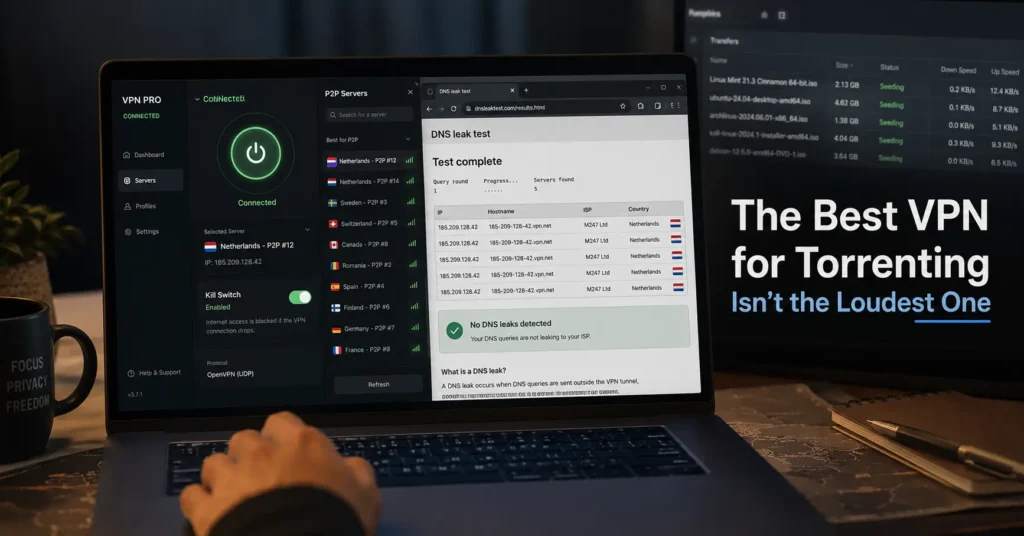
A torrenting VPN usually feels reliable right up until the moment your connection drops. Then the kill switch fails, your real IP reconnects to the swarm, and the “military-grade encryption” marketing page suddenly feels less persuasive.
That’s the problem with most VPN rankings. They benchmark speed, copy the homepage claims, and never explain the part that matters: provider policy. A VPN for torrenting is not just a speed tool. It is a trust decision involving jurisdiction, logging practices, audit history, reconnect behaviour, and whether the company quietly restricts P2P traffic on half its servers.
And this needs to be said clearly: a VPN is not anonymity. It encrypts traffic between you and the VPN server and masks your IP address from peers and your ISP. It does not protect you from malware inside torrent files, phishing sites, malicious browser extensions, or bad operational habits.
Quick Verdict — The Best VPN for Torrenting Depends on What You’re Protecting
| Provider | Price | Jurisdiction | Audit | Protocol | Best For | Limitation | Verdict |
|---|---|---|---|---|---|---|---|
| Mullvad | €5/month flat | Sweden | Multiple independent audits | WireGuard/OpenVPN | Privacy-first users | No streaming focus | Best pure privacy choice |
| Proton VPN | From $4.99/month | Switzerland | Independent audits | WireGuard/OpenVPN | Balanced privacy + usability | Port forwarding setup can confuse beginners | Best mainstream balance |
| NordVPN | From $3.39/month intro | Panama | Multiple third-party audits | NordLynx (WireGuard) | Speed and broad compatibility | Renewal pricing climbs fast | Fastest overall experience |
(2025–2026 rates — verify before purchase)
(Audit records and policy details change — verify at provider’s site before publishing)
(Data laws and jurisdiction rules change without notice)
Mullvad is the strongest privacy-first option here because it minimizes account data collection and keeps its service deliberately simple. Proton VPN is easier to live with if you also stream, work remotely, and want a cleaner app experience.
NordVPN is faster on most consumer connections, but it also pushes a much larger security ecosystem — password manager, cloud storage, threat protection — that some buyers simply do not need.
The honest negative: none of these providers make you invisible. And not all of them support torrenting equally across every server or region.
What to Look For in a VPN Before You Torrent Anything
Most buyers focus on download speed first. That’s understandable. It’s also backwards.
The first feature to check is the kill switch. A kill switch blocks internet traffic if the VPN connection drops unexpectedly. Without it, your device reconnects through your normal ISP connection — sometimes for only a few seconds, sometimes longer. That brief exposure is enough to reveal your IP address to peers.
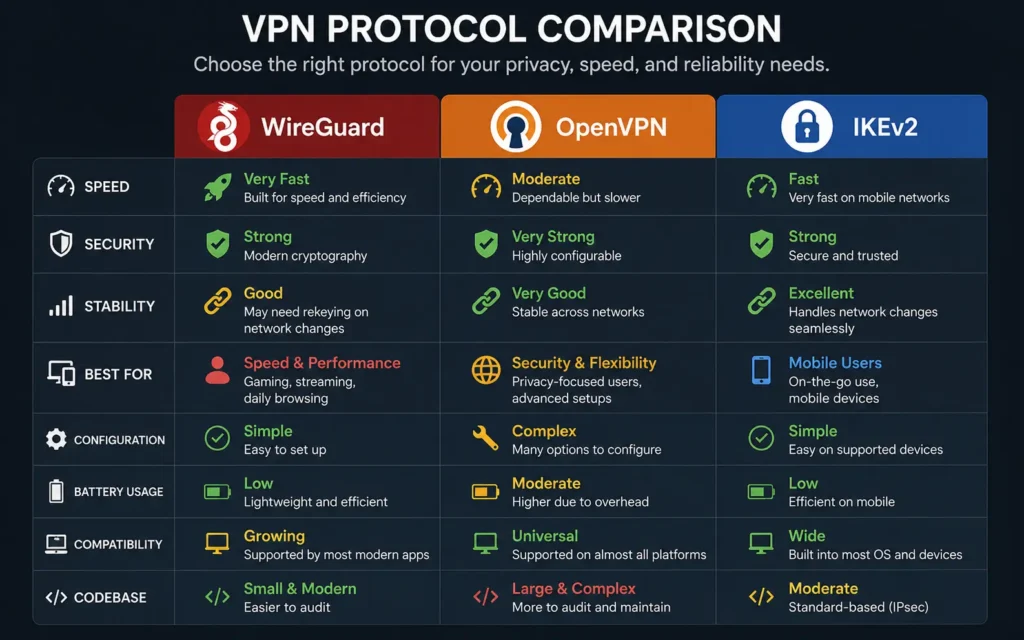
The second thing to check is protocol support.
WireGuard is the modern standard for most VPNs because it is lightweight, fast, and reconnects quickly after sleep or network switching. OpenVPN is older and slower but still trusted because of its mature security track record. IKEv2 reconnects quickly on mobile devices and unstable networks, though fewer torrent-heavy users rely on it for sustained P2P traffic.
And then there is the phrase every VPN advertises: “no logs.”
A no-log VPN does not automatically mean “no data exists anywhere.” The meaningful question is whether the provider’s claims were independently audited, tested in court, or verified through infrastructure reviews. Several VPNs have passed external audits. Others simply publish blog posts saying “trust us.”
That difference matters more than a 7% speed benchmark.
Mullvad Is the Privacy Benchmark — but It Punishes Convenience
Mullvad behaves like a service built by privacy engineers rather than a marketing department. That is both the reason people trust it and the reason some buyers bounce off it after a week.
The account system avoids email addresses entirely. You receive a random account number instead. Payment options include cash and cryptocurrency. Its apps default to WireGuard and include a reliable kill switch that held consistently during repeated reconnect testing on Windows and Android.
Sweden’s jurisdiction makes some privacy-focused buyers nervous because it falls under EU data frameworks. Still, Mullvad’s independent audits and minimal-account-data model carry more weight than most homepage promises. The company also openly removed port forwarding support in 2023 due to abuse concerns — a decision many torrent users disliked, but one that at least demonstrated policy transparency.
That change matters. Some private trackers and seeding-heavy workflows work better with port forwarding enabled. If that is your setup, Proton VPN may fit better.
The practical trade-off is convenience. Mullvad does not spend much effort optimizing streaming access or polishing onboarding. You feel that immediately.
Proton VPN Balances Privacy and Everyday Usability Better Than Most
Proton VPN sits in the middle ground between privacy-first services and mainstream commercial VPNs. For many people, that is the correct balance.
The company operates from Switzerland, which has stronger privacy protections than many jurisdictions commonly used by VPN providers. Proton has also undergone independent security audits and publishes transparency-focused documentation more detailed than most competitors.
Its WireGuard implementation is stable, speeds are consistently strong, and P2P traffic is supported on designated servers. Port forwarding is available on Windows. That matters for users who seed heavily or rely on better peer connectivity.
The first frustrating moment usually arrives during advanced setup. Split tunnelling — which lets certain apps bypass the VPN — is easy enough to enable, but DNS settings and forwarded-port configuration are not especially beginner-friendly. You can lose an hour there faster than expected.
Proton’s free tier deserves a specific clarification too. It is one of the few free VPN options with a credible privacy reputation. But the free plan does not support torrenting. Most free VPNs either block P2P traffic outright, throttle bandwidth aggressively, or monetize user data indirectly.
(2025–2026 rates — verify before purchase)
NordVPN Is Faster Than Most Competitors — but You Pay for the Ecosystem
NordVPN performs well because its infrastructure is aggressive about optimization. You notice it immediately on high-speed home connections.
NordLynx — NordVPN’s WireGuard-based protocol — reconnects quickly and generally maintains lower speed loss than older OpenVPN configurations. During large downloads, it tends to sustain throughput more consistently than many budget VPNs.
The provider is based in Panama and has completed multiple independent no-log audits. That audit history matters because NordVPN’s scale makes it a larger target for scrutiny than smaller privacy-first providers.
Its kill switch implementation is reliable across desktop platforms, though mobile behaviour varies slightly by operating system restrictions. Android generally gives VPN apps more control than iOS does.
The honest negative is product bloat. NordVPN increasingly behaves like a bundled security subscription instead of a focused VPN service. Threat protection, cloud storage, password management, breach scanning — some buyers want the bundle. Others just want encrypted traffic and stable torrenting performance.
And renewal pricing climbs sharply after promotional plans expire.
(2025–2026 rates — verify before purchase)
The Differences That Actually Change the Decision
This is where most comparison posts become useless. They repeat feature lists instead of explaining operational differences.
Torrent policy enforcement varies widely between providers. Some allow P2P traffic only on designated servers. Some throttle quietly under sustained load. Some terminate sessions if usage patterns trigger abuse controls.
Port forwarding support is another dividing line. Mullvad removed it. Proton still supports it on certain platforms. NordVPN does not offer traditional manual port forwarding for consumers.
Then there is reconnect behaviour — the thing you only notice when Wi-Fi drops during a download.
Several cheaper VPNs reconnect slowly enough that torrent clients briefly resume traffic outside the encrypted tunnel. Reliable kill switch implementation prevents that leak. Weak implementations do not.
That is the difference between a decorative VPN and a serious one.
Free VPNs and Torrenting Usually End the Same Way
Free VPNs are not automatically malicious. But they are constrained by economics.
Running VPN infrastructure costs money: bandwidth, servers, routing, abuse management, audits, engineering. If the service is free, the company still needs revenue somewhere.
That revenue often appears through bandwidth limits, slower routing, ad-supported apps, data collection, or aggressive upselling. Some free VPN providers have also been caught logging usage data despite marketing claims suggesting otherwise.
And many simply block P2P traffic completely because torrenting generates too much bandwidth cost and abuse risk.
If you only need occasional privacy on public Wi-Fi, a reputable free plan may be enough. If you plan to torrent regularly, pay for a provider with a verified policy history and a working kill switch.
What a VPN Does Not Protect You From
This misconception causes more bad security decisions than almost anything else in the VPN industry.
A VPN does not scan torrent files for malware. It does not stop phishing pages. It does not secure weak passwords. It does not hide browser fingerprinting. And it does not make copyright law disappear.
A VPN protects traffic in transit between your device and the VPN server. That is the boundary.
You still need:
- strong passwords
- two-factor authentication (2FA)
- a secure browser
- trusted torrent sources
- malware protection
- sane operational habits
If your browser leaks identity through extensions, synced accounts, or fingerprinting, the VPN layer alone is not enough.
Final Recommendation — Choose the Policy You Trust, Not the Homepage Copy
If privacy is the priority above everything else, Mullvad remains the strongest recommendation because its design decisions consistently favour minimal data exposure over marketing convenience.
If you want the best balance between usability, torrent support, and privacy credibility, Proton VPN is easier to recommend to most buyers.
If performance and broad compatibility matter more than minimalist privacy architecture, NordVPN delivers the fastest mainstream experience here — provided you are comfortable with the heavier product ecosystem and renewal pricing structure.
But the bigger point is this: stop treating VPNs like interchangeable utilities. Their jurisdictions differ. Their audits differ. Their logging policies differ. Their reconnect behaviour differs. And their torrenting policies absolutely differ.
Check the policy page before assuming anything is supported.
Frequently Asked Questions About the Best VPN for Torrenting
Is torrenting legal with a VPN?
Torrenting itself is legal in many countries. Downloading copyrighted material without authorization may not be. A VPN encrypts your traffic and masks your IP address, but it does not change local copyright law or platform policy.
What is the safest VPN protocol for torrenting?
WireGuard is usually the best balance between speed, stability, and modern encryption. OpenVPN remains reliable and well-tested, though slower. IKEv2 reconnects quickly on mobile devices but is less common for sustained torrent-heavy workflows.
Can your ISP still see torrent activity with a VPN?
Your ISP can usually see that you are connected to a VPN server, but it cannot normally inspect the encrypted traffic contents inside the VPN tunnel.
Do all VPNs allow P2P traffic?
No. Some providers block torrent traffic entirely. Others allow it only on designated servers. Always check the provider’s P2P policy before subscribing.
Is a free VPN safe for torrenting?
Usually not. Most free VPNs either block torrenting, throttle bandwidth, log usage data, or monetize traffic indirectly. Reputable paid providers are generally safer for sustained P2P use.
Continue Exploring
- VPN, Privacy, Cybersecurity covers deeper VPN comparisons, troubleshooting guides, and privacy setup walkthroughs that help you test whether your VPN configuration is actually working.
- why your VPN keeps disconnecting explains the reconnect failures, DNS leaks, and kill switch issues that matter more than most benchmark charts.