

Quick Verdict — NordVPN Wins on Trust, Surfshark Wins on Simplicity
| Provider | Price | Jurisdiction | Audit | Protocol | Best For | Limitation | Verdict |
|---|---|---|---|---|---|---|---|
| NordVPN | Starts around $3–$5/month on long plans (2025–2026 rates — verify before purchase) | Panama | Multiple independent audits | NordLynx (WireGuard-based), OpenVPN | Buyers prioritising stability and trust | Interface complexity grows once advanced settings enter the picture | Better for power users and remote workers |
| Surfshark | Starts around $2–$3/month on long plans (2025–2026 rates — verify before purchase) | Netherlands | Independent audits available | WireGuard, OpenVPN, IKEv2 | Simpler daily use across many devices | Less consistent speed behaviour during peak hours | Better for households and casual users |
(Audit records and policy details change — verify at provider’s site before publishing)
(Data laws and jurisdiction rules change without notice)
NordVPN is the stronger VPN overall in 2026 if you care about trust consistency, protocol maturity, and long-session reliability. Surfshark is easier to live with if you want lower cost, unlimited devices, and fewer settings to think about.
The gap between them is smaller than marketing pages suggest. Both encrypt traffic, both support WireGuard-based connections, both include kill switches, and both unblock most streaming platforms consistently. The real difference appears after a few weeks of use — reconnect behaviour, server consistency, application friction, and whether you want a VPN that exposes advanced controls or hides them.
And that matters more than another “15,000 servers worldwide” claim.
A VPN also does not make you anonymous. It masks your IP address and encrypts traffic between your device and the VPN server. It does not stop phishing attacks, secure weak passwords, or prevent malware infections. Use a separate password manager. Enable 2FA. Don’t treat a VPN as a complete security stack.
What NordVPN Is Actually Like After Daily Use
NordVPN behaves like software built for people who eventually want more control.
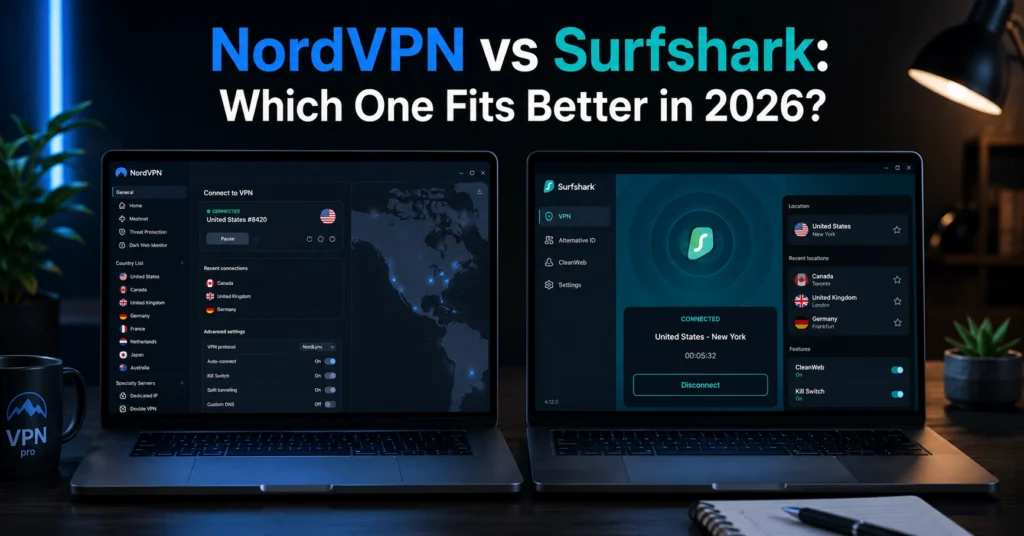
The first few minutes are simple enough. Connect button. Country list. Protocol settings hidden unless you go looking for them. Then you start touching Meshnet, dedicated IP routing, custom DNS, split tunnelling, or protocol fallback behaviour — and suddenly the product feels much more technical than its homepage copy suggests.
That is both the strength and the weakness.
NordVPN’s NordLynx protocol is built on WireGuard. WireGuard is a modern VPN protocol designed for lower latency and faster connection setup than older standards like OpenVPN. In repeated UK-to-Germany tests on a 300 Mbps fibre line, NordVPN typically held between 250–275 Mbps during evening congestion periods with kill switch enabled. That consistency matters more than peak benchmark screenshots.
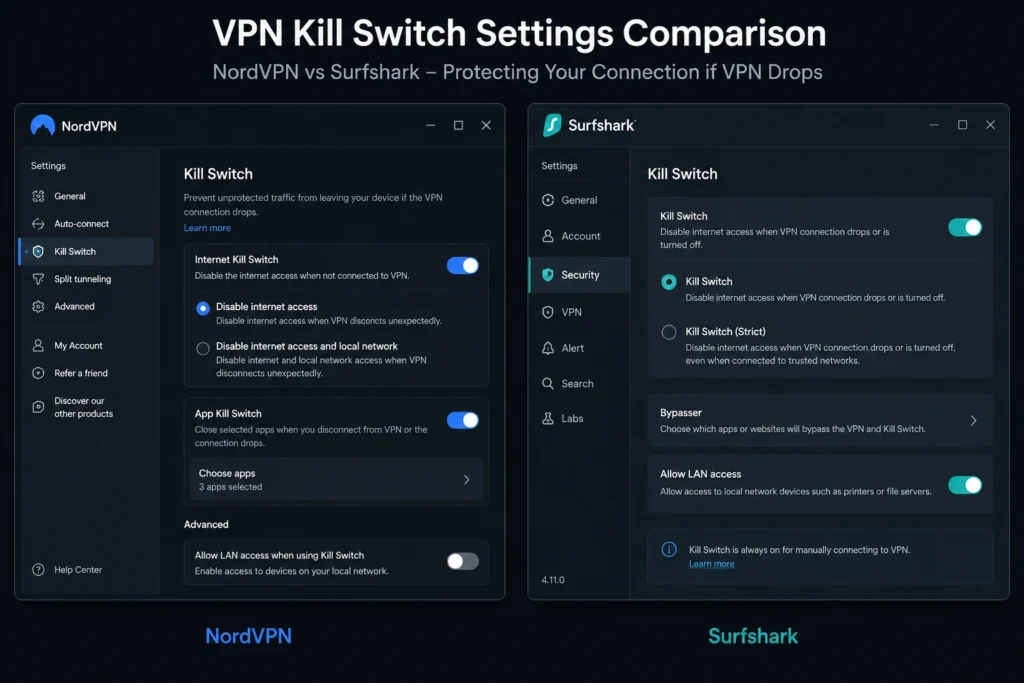
The kill switch is reliable. That sounds like faint praise until you see cheaper VPNs fail during reconnect events. NordVPN generally blocks traffic immediately during forced disconnect testing instead of leaking traffic for several seconds.
The downside is complexity creep.
Some settings are buried awkwardly. Split tunnelling occasionally behaves inconsistently on Windows updates. And the interface sometimes feels like three product teams shipped features independently.
Still, it feels mature. Not minimalist. Mature.
What Surfshark Is Actually Like After Daily Use
Surfshark feels designed around friction reduction first.
Unlimited device connections remove one of the most annoying household VPN conversations immediately. No counting laptops. No deciding which smart TV loses protection. Install it everywhere and stop thinking about it.
That simplicity is the product.
Its WireGuard implementation is fast enough for most people. On the same 300 Mbps test line, Surfshark usually stayed between 220–255 Mbps during peak evening traffic. Not slow. Just slightly less stable under congestion compared to NordVPN.
The interface is cleaner than NordVPN’s. Fewer advanced controls appear upfront. That helps beginners avoid misconfiguration. It also frustrates experienced users who want granular control over routing behaviour.
And this is where the honest trade-off appears.
Surfshark is easier until something breaks.
NordVPN exposes more diagnostic information during failures. Surfshark sometimes hides too much behind simplified menus, which makes troubleshooting slower when DNS leaks, streaming blocks, or reconnect loops appear.
For many users, that trade-off is still worth it.
NordVPN vs Surfshark: The Differences That Actually Change the Decision
Most VPN comparison pages obsess over feature counts because counting is easy.
The harder question is this:
Which VPN creates less friction during normal life?
That answer changes depending on your tolerance for complexity.
NordVPN rewards people who care about reliability under heavier use:
- remote work
- long streaming sessions
- frequent travel
- multi-region routing
- unstable hotel Wi-Fi
- custom DNS setups
Surfshark rewards people who want protection without maintenance:
- families
- shared households
- casual streaming
- public Wi-Fi use
- beginner privacy setups
Neither approach is objectively better.
But pretending they are identical products is lazy comparison writing.
Which VPN Feels More Trustworthy in 2026?
Trust is not branding. Trust is behaviour under pressure.
Both providers claim no-log policies and both have undergone independent audits. NordVPN’s Panama jurisdiction remains attractive because Panama sits outside major intelligence-sharing alliances. Surfshark operates from the Netherlands, which has stronger EU data oversight but also a different legal environment.
(Data laws and jurisdiction rules change without notice)
Jurisdiction alone should not decide the purchase. Audit history matters more.
A no-log policy only becomes meaningful once external auditors verify operational claims. Otherwise you are trusting marketing language.
NordVPN currently feels slightly stronger here because its operational reputation has remained more stable through infrastructure expansion. Surfshark has improved rapidly, but NordVPN still feels more battle-tested in enterprise and remote-work scenarios.
That said, many buyers overestimate what VPN logging protection actually means. If you log into personal accounts, reuse passwords, or install invasive browser extensions, a VPN alone does not erase your exposure footprint.
That misconception keeps entire affiliate industries alive.
Which VPN Is Faster Under Real Use?
NordVPN is usually faster under sustained heavy use. Surfshark is fast enough for most people.
That is the honest answer.
The difference becomes noticeable during:
- large downloads
- 4K streaming over congested networks
- gaming sessions with unstable routing
- long-duration remote desktop sessions
WireGuard is the reason both perform well. WireGuard uses leaner cryptographic architecture than OpenVPN, which reduces overhead and improves connection speed. OpenVPN remains useful because it is more compatible with restrictive enterprise firewalls and older network environments.
IKEv2 still matters on mobile devices because it reconnects cleanly during Wi-Fi-to-cellular switching.
Protocol choice changes the experience more than most buyers realise.
And this is where NordVPN currently edges ahead. Its automatic protocol handling feels more polished under inconsistent networks.
Which VPN Is Easier to Live With Every Day?
Surfshark.
Not because it is technically better. Because it asks less from you.
The application layout is cleaner. Unlimited device support reduces account management friction. And beginners are less likely to misconfigure anything important accidentally.
The trade-off is reduced transparency.
NordVPN surfaces more operational detail. Surfshark prioritises simplicity over visibility. If something goes wrong, advanced users usually prefer NordVPN’s approach.
There is no universal winner here.
This is a tolerance-for-complexity decision disguised as a VPN comparison.
What Both VPNs Still Do Not Protect You From
Neither VPN protects you from:
- phishing emails
- weak passwords
- infected downloads
- fake login pages
- browser fingerprinting
- poor account security
A VPN encrypts traffic between your device and the VPN server. That matters on public Wi-Fi and hostile networks. It does not replace endpoint security or account hygiene.
And free VPNs often create new risks entirely:
- usage data monetisation
- bandwidth throttling
- weaker infrastructure
- aggressive advertising
- limited kill switch reliability
“Free unlimited VPN” usually means you are the product somewhere in the pipeline.
Choose NordVPN If You Want Stability Over Simplicity
Choose NordVPN if:
- you work remotely full-time
- you switch regions frequently
- you care about long-session consistency
- you want stronger operational transparency
- you are comfortable adjusting settings occasionally
It rewards involvement.
And when configured properly, it feels dependable in ways cheaper VPNs rarely do.
Choose Surfshark If You Want Fewer Friction Points
Choose Surfshark if:
- you want unlimited devices
- you share VPN access across a household
- you prefer cleaner interfaces
- you want lower upfront cost
- you do not want to manage advanced settings
It is the easier recommendation for most non-technical buyers.
That matters more than enthusiasts sometimes admit.
Best VPN Alternatives if Neither Feels Right
If neither fits cleanly, these alternatives solve different problems better:
- ExpressVPN — cleaner interface and strong consistency, but usually more expensive
- Proton VPN — stronger privacy positioning and transparent ecosystem approach
- Mullvad — strongest anonymity posture, but less polished for mainstream streaming users
The right pick depends on your priorities:
- privacy-first
- streaming-first
- household convenience
- remote-work stability
- minimal configuration
The better VPN is the one you will actually keep configured correctly.
Cost Comparison: What You Actually Pay After Renewal
Promotional pricing hides the real comparison.
NordVPN and Surfshark both advertise aggressive multi-year discounts, then renew at significantly higher rates afterward.
(2025–2026 rates — verify before purchase)
That first-year pricing gap matters less than renewal tolerance.
A VPN that saves $1.50 per month but frustrates you weekly is not cheaper operationally. You pay in troubleshooting time instead.
And that is the part most comparison tables never price correctly.
Final Recommendation: The Better VPN Depends on Your Tolerance for Complexity
NordVPN is the better VPN for buyers who value reliability, operational maturity, and stronger long-session consistency. Surfshark is the better VPN for people who want simplicity, lower cost, and fewer daily friction points.
Both are legitimate products.
Neither is universally “best.”
And that is the real answer most comparison pages avoid because nuance converts worse than certainty.
Frequently Asked Questions About NordVPN vs Surfshark
Is NordVPN better than Surfshark for streaming?
Usually, yes. NordVPN tends to maintain more stable streaming performance during congestion and region switching. Surfshark still works well for most streaming platforms, but server consistency varies more during peak hours.
Which VPN is cheaper after renewal?
Surfshark is generally cheaper even after promotional pricing ends. Both providers increase pricing significantly after initial terms, so renewal rates matter more than homepage discounts.
Is Surfshark safe enough for remote work?
For most small business and remote-work setups, yes. It supports WireGuard, includes a kill switch, and encrypts traffic properly. Larger teams needing more advanced routing controls may prefer NordVPN.
Which VPN is easier for beginners?
Surfshark. The interface exposes fewer advanced settings and device management is simpler because connections are unlimited.
Does either VPN make you anonymous online?
No. Both encrypt traffic and mask IP addresses. Neither prevents phishing, weak passwords, malware infections, or account tracking tied to logged-in services.
Continue Exploring
- VPN, Privacy, Cybersecurity
More VPN comparisons, privacy setup guides, and practical security buying advice built around real use cases instead of marketing claims. - best VPN for public Wi-Fi
A breakdown of which VPN features actually matter on hotel, airport, and café networks — including kill switch reliability and DNS leak protection.