

| Provider | ProviderNordVPN | ProviderExpressVPN |
| Jurisdiction | JurisdictionPanama | JurisdictionBritish Virgin Islands |
| Audit | AuditPwC / Deloitte Independent Audited | AuditKPMG / PwC Certified |
| Protocol | ProtocolWireGuard (NordLynx), OpenVPN | ProtocolLightway, OpenVPN |
| Best For | Best ForComplete operating system encryption and consumer privacy | Best ForRouter-level network deployment and high-speed multi-device coverage |
| Limitation | LimitationHigher operational latency than unencrypted proxy streams | LimitationPremium cost tiers relative to open datacenter proxy configurations |
| Verdict | VerdictThe default choice for data protection and public network security | VerdictBest for seamless cross-platform deployment where performance cannot drop |
[What network routing rewards — and what it punishes if you choose the wrong tunnel]
The fundamental choice between a vpn vs proxy comes down to the boundary between app-level routing and full-system data protection. Most buyers treat these technologies as interchangeable tools for changing an IP address. They are not. Choosing the wrong infrastructure for your workflow will either break your data automation pipelines or leave your unencrypted login credentials visible on the host network.
This post cuts through the marketing fluff to isolate the structural differences in how proxies and virtual private networks process data. You will see exactly how each technology treats network packets, where the security boundaries lie, and how to allocate your software budget without wasting money on redundant tools.
[The architecture of a proxy: application-specific data routing]
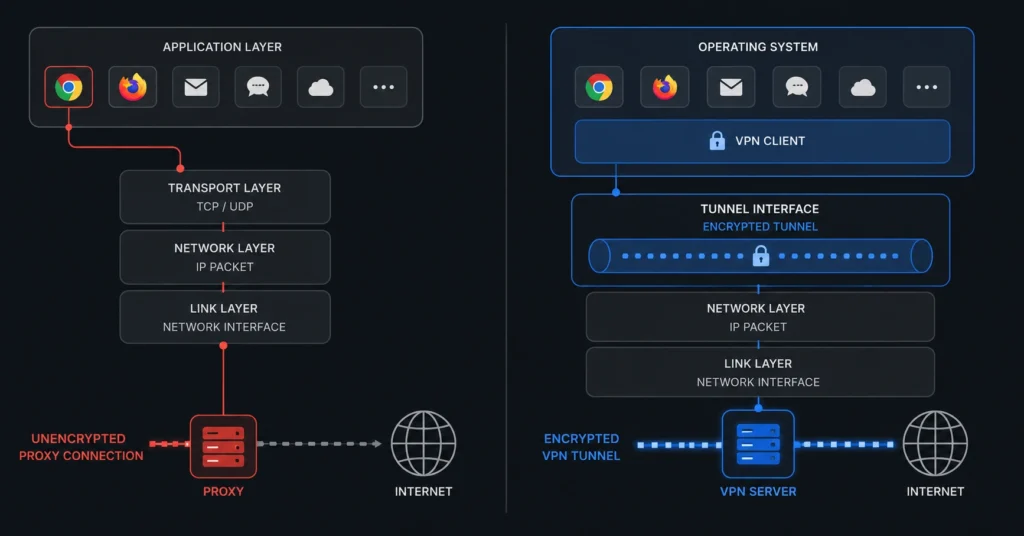
A proxy explained simply is a gateway operating at the application layer of your network stack. When you configure an HTTP or SOCKS5 proxy, you are instructing a single application — like a web browser or a terminal script — to route its requests through an intermediary server.
The proxy strips your original IP address, substitutes its own identifier, and relays the packet to the destination server.
[Web Browser] ---> (Unencrypted Proxy Lane) ---> [Proxy Server] ---> [Target Website]
The core limitation of this framework is the complete lack of structural encryption. A standard proxy server acts as a middleman, but it does not wrap your data in a cryptographic tunnel. The connection between your machine and the proxy node remains exposed to network eavesdropping.
If your password manager transmits an unencrypted payload over a proxy connection, an operator on that local network can sniff the packet.
Furthermore, data laws and jurisdiction rules change without notice, making the physical location of that proxy node critical for corporate data compliance. If you route automation scripts through a data center proxy hosted in an invasive legal jurisdiction, that data remains subject to local interception policies. A proxy is fundamentally a routing utility, not an internet privacy basics toolkit item.
[The architecture of a VPN: network-wide operating system encryption]
A virtual private network (VPN) operates at the network interface layer of your operating system. Instead of intercepting traffic from a specific program, a VPN creates a virtual network adapter that captures all outgoing data packets from your machine. Whether it is a background cloud backup utility, an email sync service, or a browser tab, every single bit goes through the exact same pipeline.
[Operating System] === (AES-256/WireGuard Tunnel) ===> [VPN Server] ---> [Target Website]
This capture mechanism relies on modern cryptographic frameworks like WireGuard, OpenVPN, or IKEv2. Before a single packet leaves your device, the VPN protocol encrypts the payload using AES-256 or ChaCha20 encryption standards. This means that your Internet Service Provider, network administrators, or local actors see nothing but incomprehensible code.
The built-in safety net is the kill switch — a firewall rule configured to completely disable internet access if the VPN connection drops unexpectedly. Without this, your machine would silently fallback to your local unencrypted network, exposing your true IP address during transient server drops. (Audit records and policy details change — verify at provider’s site before publishing).
[VPN vs Proxy: The Core Technical Differentiators]
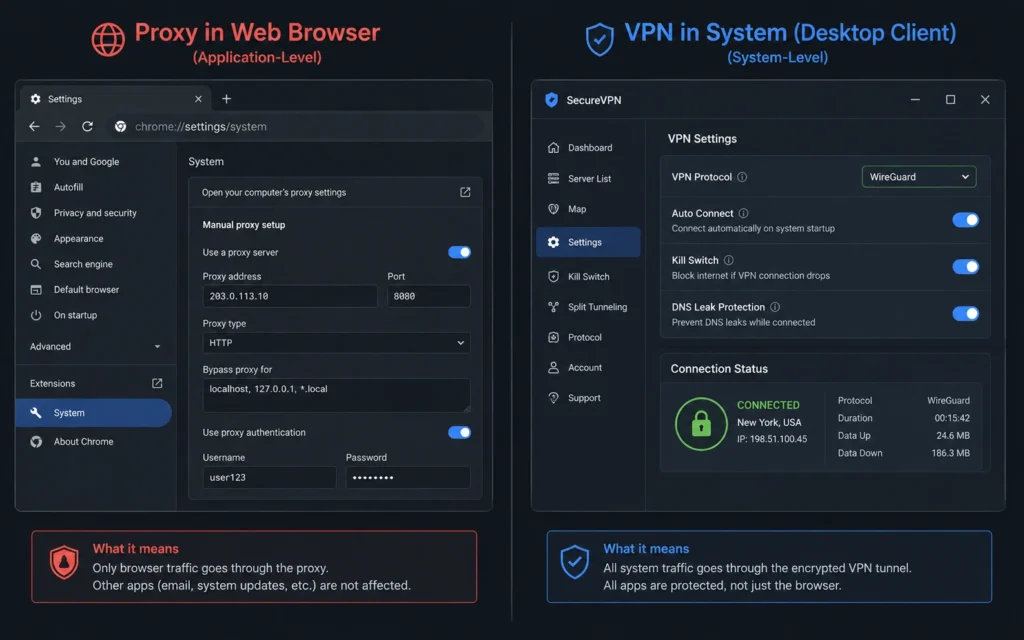
The operational differences between a proxy vs vpn show up immediately under heavy network load or protocol verification tests. The underlying technology alters your connection speed, processing overhead, and vulnerability profile across your entire local network.
- Encryption Depth: A premium VPN encrypts your entire operating system output; a proxy configuration handles plain text packets at the app layer.
- Latency Overhead: Proxies have lower latency because they omit the cryptographic handshake process required by modern VPN protocols.
- Connection Scope: Toggling a browser proxy leaves your background torrent clients, system updates, and messaging apps completely exposed on your local IP.
- Protocol Reliability: VPN connections running WireGuard handle packet loss and network handoffs smoothly, whereas application proxies frequently fail or drop sessions when switching from Wi-Fi to mobile networks.
[When to deploy a proxy over a dedicated virtual private network]
You should deploy a proxy when you require high-velocity data extraction or granular geographic targeting across thousands of separate endpoints. Large-scale enterprise operations use residential proxy networks to simulate distributed global traffic.
In high-volume web scraping or competitive intelligence operations, routing traffic through an encrypted VPN tunnel is a waste of computing power. The encryption overhead slows down request cycles and adds unnecessary processing strain to your scraper instances.
Proxies are also the standard configuration for localized ad verification and hyper-local pricing checks. For example, if an e-commerce platform needs to confirm that localized product listings display accurately across forty distinct ZIP codes, setting up forty separate system-wide VPN tunnels is an administrative failure. A simple script passing rotating proxy credentials directly via an HTTP client handles this task in seconds.
[When to deploy a VPN over an application proxy]
You must use a VPN when your primary goal is data protection, asset isolation, or securing human operators on untrusted networks. If a remote employee connects to a corporate database from a public airport network, an application proxy provides zero defense against session hijacking or side-channel inspection. The connection must run through a network-wide encrypted tunnel to safeguard access tokens and company assets.
A VPN is also mandatory when managing sensitive data flows that span multiple background services. When working with custom software tools, local staging environments, or database connections that do not natively support proxy configurations, a VPN ensures everything remains inside a unified security boundary.
If your workflow involves handling credentials, customer records, or financial information, substituting a proxy for a verified VPN is an unacceptable operational risk.
[What it costs: real numbers across three tiers]
Network routing costs are divided by deployment volume and infrastructure type. If you need system-wide consumer privacy, you buy a flat-rate subscription. If you need enterprise data collection, you pay per gigabyte of proxy traffic.
Cost Tier Overview
- Budget Tier: Free public proxies or low-tier browser extensions. These cost $0 but punish you by logging your traffic, injecting tracker scripts, or dropping connections every few minutes. Avoid them for any commercial or professional use.
- Mid-Range Tier: Flat-rate commercial VPN subscriptions. (2025–2026 rates — verify before purchase). For a monthly rate between $3 and $12, services like NordVPN or ExpressVPN provide system-wide AES-256 encryption, verified no-log infrastructures, and reliable kill switch mechanisms across multiple devices.
- Worth-the-Splurge Tier: Premium rotating residential or mobile proxy pools. These platforms charge based on data consumption, typically ranging from $8 to $15 per gigabyte. This is where enterprise platforms invest thousands of dollars monthly to run high-volume data operations without triggering firewall blocks or IP bans.
Nordvpn – 1-Year / 6-Devices – Global
Frequently Asked Questions About VPNs and Proxies
Does a proxy hide your internet history from an ISP?
No. A standard HTTP or SOCKS proxy does not encrypt the connection between your machine and the proxy server. Your Internet Service Provider can still see the data packets, URLs, and content you access. It only masks your IP address from the final website destination.
Can you use a VPN and a proxy at the same time?
Yes, you can chain them by routing your VPN traffic through a proxy server. However, this is rarely necessary for regular workflows and will significantly increase network latency. For standard security and deployment, a standalone VPN protocol is faster and more reliable.
Are free proxy servers safe for handling sensitive corporate data?
No. Free proxy servers must monetize their infrastructure, which usually involves logging user traffic, injecting advertisements, or selling connection data to third parties. They also lack structural security protocols like AES-256 encryption, exposing your raw data to interception on public networks.
Continue Exploring
- VPN, Privacy, Cybersecurity Learn more about how modern encryption protocols shield corporate workflows from local network exploitation.