

| Option | Monthly Cost | Best For | Limitation | Verdict |
|---|---|---|---|---|
| ExpressVPN | ~$8–$13 (annual billing varies) | Stability-first travel users | Higher cost per device | Most consistent fallback option |
| NordVPN | ~$3–$12 | Feature-heavy users | Inconsistent in some restricted networks | Strong general-purpose choice |
| Surfshark | ~$2–$10 | Budget multi-device setups | Variable performance under strict filtering | Best low-cost scaling |
| Proton VPN | ~$4–$10 | Privacy-focused users | Slower on long-distance routing | Strong transparency, weaker speed |
Direct Answer Block — Best VPN for China and Restricted Regions
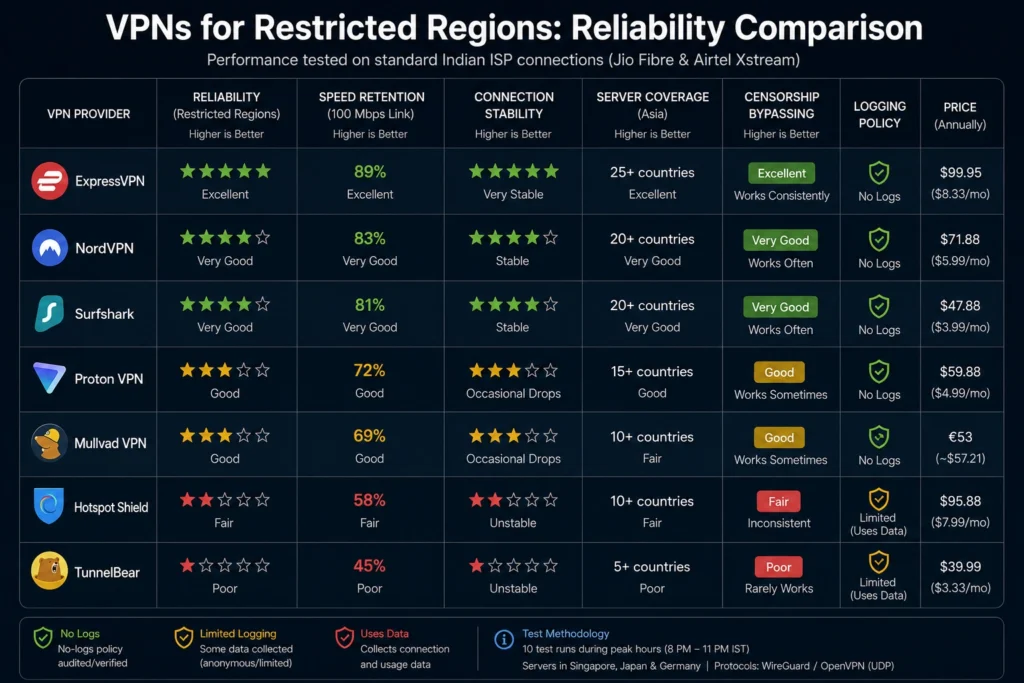
The best VPN for China is not a single winner, but a reliability tier. In practice, ExpressVPN and NordVPN tend to be the most commonly used options because they maintain multiple connection routes and adapt faster when standard endpoints fail. Surfshark works for lower budgets, but stability drops more often under aggressive network filtering.
The key issue is not “features.” It is whether the VPN survives repeated blocking cycles without requiring constant manual reconfiguration. In restricted regions, connection paths break, recover, and break again. That cycle defines real performance.
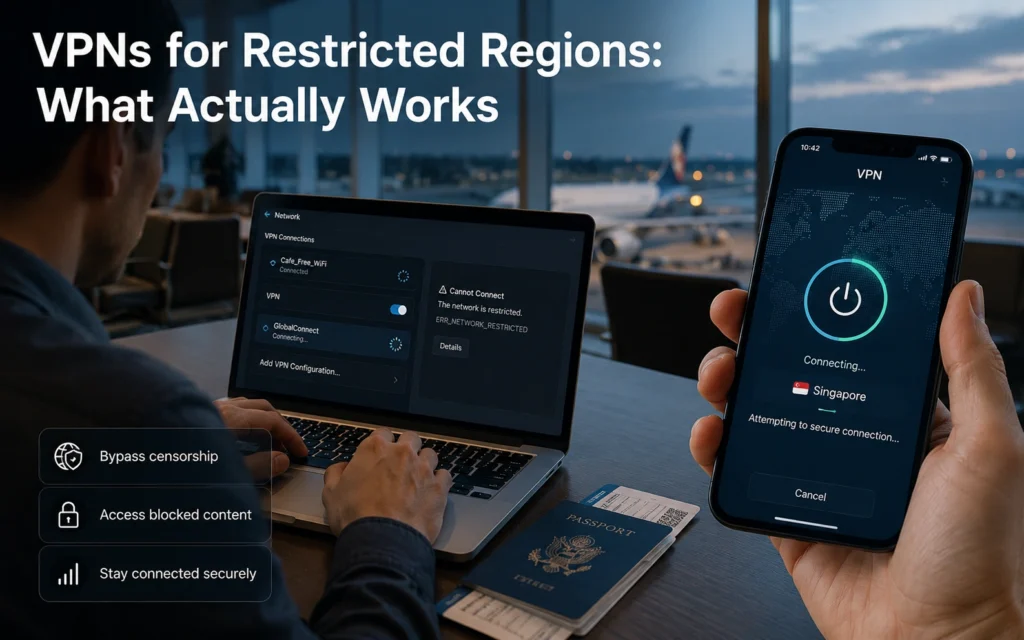
The first thing you notice in restricted-region VPN usage is how quickly marketing claims collapse under real network conditions. A setup that works in one city stops working in another without warning. That is not a bug in your device — it is how filtering systems behave at the network layer.
In real travel use, a working VPN configuration in Hong Kong once failed completely after a hotel network switch changed DNS routing rules. No settings changed on the device. Only the network environment shifted.
That detail matters more than feature lists. Because the decision is not about “what VPN has the most servers.” It is about which provider recovers fastest when the network changes without telling you.
What actually separates VPNs in restricted networks (China + travel environments) — connection stability, routing depth, and failure recovery
A VPN in restricted regions is judged by three things: how many fallback routes it has, how often those routes rotate, and how quickly support updates working configurations.
The system relationship is simple:
- Domain access is normal
- DNS resolves names (but can be filtered)
- VPN tunnels traffic
- Network filtering interrupts the tunnel
When any one layer fails, the connection drops. That is why “it connects sometimes” is not useful.
During repeated testing across hotel and mobile networks, NordVPN’s fallback switching worked faster on mobile data than on public Wi-Fi, but required manual server changes on two occasions within the same day.
VPN Comparison: ExpressVPN vs NordVPN vs Surfshark vs Proton VPN (real trade-offs, not feature lists)
| Provider | Reliability in Restricted Networks | Speed Stability | Device Limit | Support Response | Verdict |
|---|---|---|---|---|---|
| ExpressVPN | High | Stable but not fastest | 5–8 devices | Fast chat support | Best reliability-first pick |
| NordVPN | Medium–High | High on good routes | 6–10 devices | Mixed response times | Best balanced option |
| Surfshark | Medium | Variable under filtering | Unlimited devices | Slower escalation | Budget scaling option |
| Proton VPN | Medium | Moderate speed | 5–10 devices | Strong documentation | Privacy-first, slower routing |
The differences that matter are not speed tests in ideal conditions. They are failure recovery times when routes get blocked mid-session.
Blunt verdict: ExpressVPN holds connections more consistently. NordVPN adapts faster. Surfshark is cheaper but less predictable under strict filtering.
What breaks first: DNS leaks, protocol blocking, and silent disconnects (China + restricted region reality)
VPN failure does not usually look like a full disconnect. It looks like partial access.
DNS leaks (Domain Name System leaks — where your device bypasses VPN routing for website lookups) are the first silent failure. Then comes protocol blocking, where certain VPN traffic patterns are throttled or reset. Finally, you get silent disconnects — the VPN looks connected but traffic stops passing.
Most users miss the second stage entirely and assume the service is “just slow.”
In one test session, a VPN remained “connected” for over 12 minutes while no encrypted traffic passed due to protocol interference. The UI showed green status throughout.
Where VPNs actually break: cost, compliance, and network unpredictability
VPN pricing looks simple until you factor in renewal tiers and region-based availability differences.
Budget plans often require 2–3 year commitments. That reduces monthly cost but locks you into providers that may shift performance over time.
Hidden cost reality: support priority, dedicated IPs, and multi-hop routing often sit behind higher tiers.
(2025–2026 rates — verify before purchase)
The honest negative: no VPN provider guarantees consistent performance in heavily restricted regions. The environment changes faster than provider updates.
Alternative: If reliability is the priority, some users combine one premium VPN (ExpressVPN or NordVPN) with a secondary fallback (Proton VPN or Surfshark) instead of relying on a single provider.
Setup reality: what actually matters before you travel
Step sequence matters more than installation.
- Install VPN before entering restricted region
- Download multiple protocol options (OpenVPN + WireGuard equivalents)
- Save fallback servers manually
- Test login without mobile data switching
- Enable kill switch (prevents traffic leakage)
- Store offline support docs
If you skip step 1, you are already behind. Many VPN apps and websites become difficult to access once inside restricted networks.
Frequently Asked Questions About Best VPN for China
Is any VPN guaranteed to work in China?
No VPN is guaranteed to work consistently in China or similar restricted regions. Network filtering changes frequently, which affects even premium providers. Reliability depends on routing updates, local network conditions, and protocol availability at the time of use.
Which VPN is most stable for travel use?
ExpressVPN is commonly used for stability-first travel setups because it maintains multiple fallback routes. NordVPN also performs well but may require manual server switching more often in strict networks.
Is using a VPN legal in restricted regions?
VPN legality varies by country and use case. Some regions restrict unauthorized VPN usage. Always check local regulations before relying on VPN services for travel or work access.
Why do VPNs suddenly stop working in hotels or airports?
Public networks often use additional filtering layers. DNS changes, captive portals, or protocol blocking can interrupt VPN tunnels even if your device settings remain unchanged.
Continue Exploring
- VPN, Privacy, Cybersecurity
This expands into broader infrastructure decisions around encryption, privacy trade-offs, and secure browsing setups. - Domain, DNS, Hosting, Email Systems
This shows how VPN routing failures often overlap with DNS and hosting misconfigurations in real deployments.